



 MENU TOP



Basic Views and Basic Policy on Corporate Governance
Under its corporate philosophy of “Earn the trust of society through corporate activity based in integrity,” the Group recognizes that the primary objective of corporate governance is to become a company trusted by society and all stakeholders by contributing to the development of the economic community through corporate activities based on strict compliance.
Through such efforts, the Group aims to realize corporate management that embodies transparency, fairness, and efficiency.
Based on this fundamental approach to corporate governance, the Company is committed to enhancing its corporate governance framework in accordance with the following basic principles, in order to achieve sustainable growth and enhance medium- to long-term corporate value through transparent, fair, prompt, and decisive decision-making.
- To respect the rights of shareholders and ensure the equitable treatment of all shareholders
- To engage in appropriate cooperation with all stakeholders, including shareholders
- To ensure transparency by appropriately disclosing financial and non-financial information and other corporate information
- To ensure that the Board of Directors appropriately fulfills its roles and responsibilities, including securing the effectiveness of its oversight of business execution, in light of its fiduciary responsibility to shareholders
- To engage in constructive dialogue with shareholders in order to contribute to sustainable growth and the enhancement of corporate value over the medium- to long-term
Overview of the Corporate Governance Structure
Corporate Governance Structure
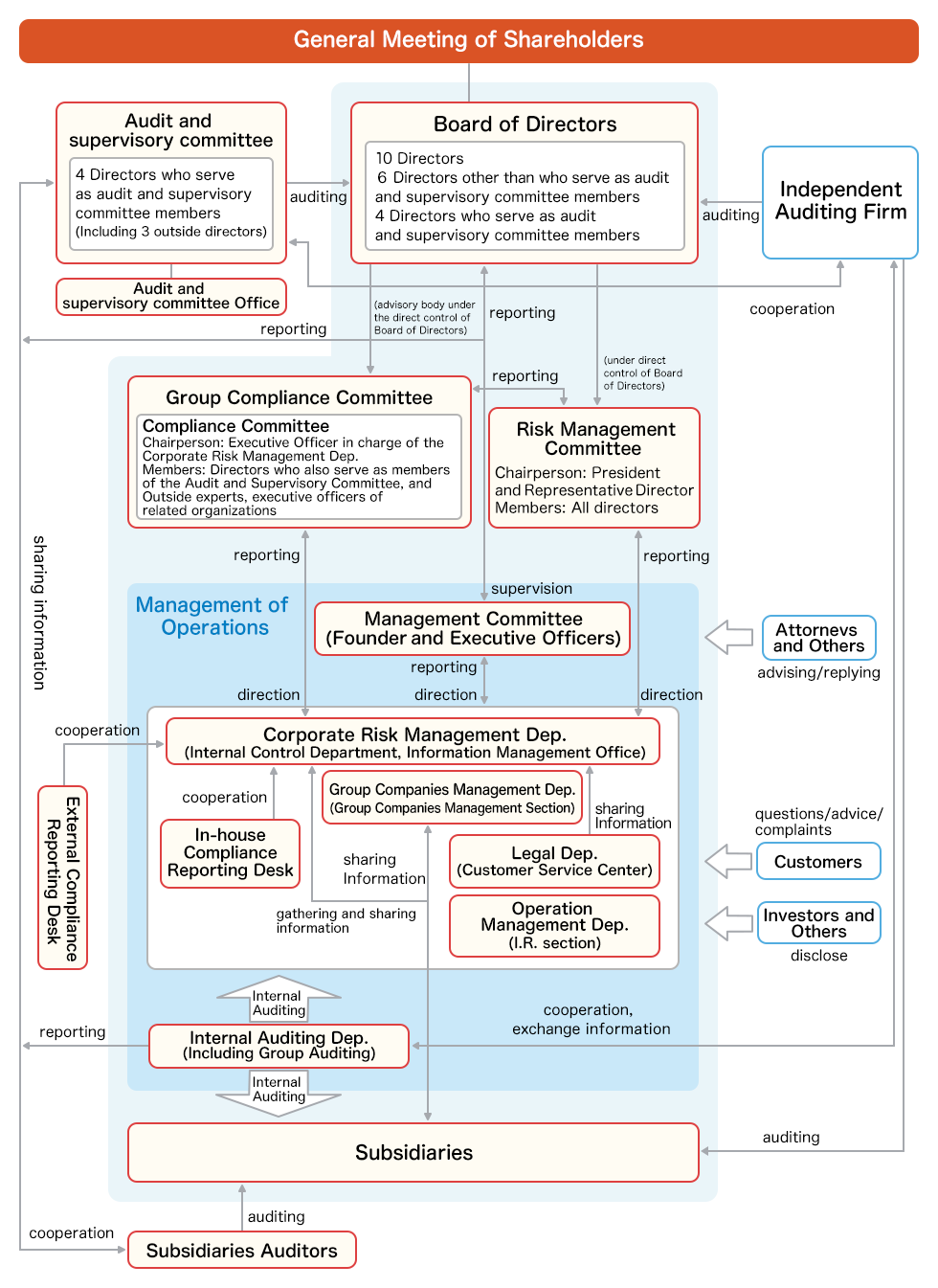
In order to strengthen the supervisory function of the Board of Directors and enhance corporate governance, the Company has adopted a structure as a Company with an Audit and Supervisory Committee.
Audit and Supervisory Committee and Directors Who Are Members of the Audit and Supervisory Committee
The Audit and Supervisory Committee consists of four directors (including three directors who are outside members). It determines items such as the audit policy and plan, and discusses and decides on important audit matters based on the reports it receives. In addition to these performing these duties, it also audits legitimacy and appropriateness through the use of the internal control system. A meeting will generally be held every month, with extraordinary meetings held when necessary.
The directors who are members of the Audit and Supervisory Committee will cooperate with the Internal Auditing Department and the accounting auditors to enhance management’s supervisory functions. They will also share information with the auditors of affiliated companies in an effort to strengthen the auditing structure for the operations of the entire Group.
To improve these audit functions, the Group will establish an Auditor’s office as the exclusive body for supporting the duties of directors who belong to the Audit and Supervisory Committee. It will also take the necessary steps to secure independence, such as by requiring that the Auditor’s office does not follow any directions or orders from directors (other than directors belonging to the Audit and Supervisory Committee) when carrying out their duties.
Board of Directors and Directors
As of the date of submission of this report, the Board of Directors consists of a total of ten directors, comprising six directors (excluding directors who are members of the Audit and Supervisory Committee) and four directors who are members of the Audit and Supervisory Committee.
The Board of Directors deliberates on and determines important matters of business execution stipulated in laws and regulations or the Articles of Incorporation that cannot be delegated to directors or executive officers, as well as matters defined as important business execution under the Board of Directors Regulations, including management plans, human resources policies, and capital policies.
In addition, based on policies resolved by the Board of Directors, authority is appropriately delegated to executive officers and other personnel, in accordance with the Rules on Authority and Responsibility, with respect to business execution and the disposition of assets below a specified monetary threshold. The Board supervises the status of such delegated authority and its execution.
In principle, meetings of the Board of Directors are held twice a month, and extraordinary meetings are held as necessary. The Articles of Incorporation provide that the number of directors (excluding directors who are members of the Audit and Supervisory Committee) shall not exceed fifteen, and the number of directors who are members of the Audit and Supervisory Committee shall not exceed five.
Outside Directors
As of the date of submission of this report, the Company has appointed one outside director out of the six directors (excluding directors who are members of the Audit and Supervisory Committee), and three outside directors out of the four directors who are members of the Audit and Supervisory Committee.
A framework has been established that enables outside directors to attend and express opinions at important meetings and committees, including the Compliance Committee.
Executive Officers
For the purpose of accelerating decision-making and business execution, and strengthening the separation between supervisory and executive functions, the Company has introduced an executive officer system. Executive officers are appointed by the Board of Directors, and their respective responsibilities and authorities are defined, with business execution entrusted accordingly.
Management Committee
The Management Committee consists of all executive officers and founders. It conducts prior deliberations on matters to be resolved by the Board of Directors, as well as deliberations or resolutions on important matters related to business execution. Through information sharing and mutual supervision regarding issues and strategies based on policies resolved by the Board of Directors, the Company endeavors to prevent discrepancies between decision-making and business execution. In principle, the Management Committee is convened on a weekly basis.
Group Compliance Committee
The Company has established the Group Compliance Committee as an advisory body directly reporting to the Board of Directors. The Committee is chaired by the Executive Officer in charge of the Risk Management Division, as approved by the Board of Directors, and is composed of external experts, directors who are members of the Audit and Supervisory Committee, and executive officers from relevant departments. With the aim of fostering a corporate culture that emphasizes compliance, establishing corporate ethics, and promoting compliance programs, the Committee deliberates on and makes recommendations regarding important matters related to compliance, and reports to the Board of Directors as necessary. In principle, the Committee is held twice a year, and extraordinary meetings are convened as required.
Group Risk Management Committee
The Company has also established the Group Risk Management Committee as an organization directly reporting to the Board of Directors. The Committee is chaired by the President and CEO, and consists of all directors. With the aim of preventing risks before they materialize through the establishment of an appropriate risk management framework and minimizing losses in the event of a crisis, the Committee receives regular reports on risk conditions, continuously monitors risks, conducts ongoing reviews of the risk management framework, and reports to the directors as necessary. In principle, the Committee is held twice a year, and extraordinary meetings are convened as required.
(Policy on Election/dismissal of Management Executives and Naming of Prospective Directors) The Company believes that, in order to establish a long-term vision and enhance medium- to long-term corporate value, it is necessary to ensure diversity and expertise in the composition of the Board of Directors, as well as an appropriate balance of knowledge, experience, and capabilities. Based on this understanding, the Company has established the following policies for the appointment of senior management and the nomination of director candidates, selecting from a broad range of internal and external candidates.
- Individuals with extensive experience, high levels of insight, advanced expertise, strong ethical standards, and outstanding character, who are capable of fairly and appropriately executing management and business operations of the Company Group
- Candidates for independent outside directors who satisfy the Company’s independence criteria, understand the Company’s management philosophy, fully recognize their role as independent outside directors, and are capable of supervising management and providing appropriate and constructive advice based on their experience, insight, and expertise For the appointment of senior management, the Company discloses, in the Notice of Convocation of the General Meeting of Shareholders, the reasons for nominating each director candidate together with their brief biographies, thereby enabling shareholders to understand the experience and skills of the appointed directors. Independent outside directors include individuals with experience in corporate management at other companies. With respect to the dismissal of senior management, the Board of Directors makes decisions in accordance with the Company’s dismissal criteria, taking into account circumstances such as fraud, improper conduct, or breach of trust. (Process for Election/dismissal of Management Executives and Naming of Prospective Directors) The procedures for the appointment and dismissal of senior management and the nomination of director candidates are as follows:
- Director candidates are nominated based on proposals from the President and CEO and the executive officer in charge of personnel, followed by the collection of opinions from the Audit and Supervisory Committee (a majority of whose members are independent outside directors), and are then deliberated and determined by the Board of Directors
- Candidates for directors who are members of the Audit and Supervisory Committee are determined by the Board of Directors with the consent of the Audit and Supervisory Committee
- The Representative Director is appointed by resolution of the Board of Directors
- The roles and titles of directors are determined by resolution of the Board of Directors, taking into account performance and evaluations
- The dismissal of directors is resolved by the Board of Directors in accordance with the relevant policies and is ultimately determined by the General Meeting of Shareholders
Reasons for Adoption of Current Corporate Governance System
The Company has adopted a structure as a Company with an Audit and Supervisory Committee, under which three of the four directors who are members of the Audit and Supervisory Committee are outside directors. All directors who are members of the Audit and Supervisory Committee attend meetings of the Board of Directors, as well as important meetings and committees, including the Compliance Committee.
In addition, the Company has established a reporting framework to the Audit and Supervisory Committee in order to ensure the effectiveness and independence of audits.
Furthermore, to enhance the effectiveness of the audit function, the Company has established the Audit and Supervisory Committee Office as a dedicated department to assist the Audit and Supervisory Committee in the performance of its duties.
In addition, the Company has introduced an executive officer system to promote the separation of supervisory and executive functions. The Company has also established the Compliance Committee and the Risk Management Committee, which include external experts as members, in order to further strengthen its supervisory functions.
Through these arrangements, the Company has adopted its current corporate governance structure with the aim of realizing corporate management that embodies transparency, fairness, and efficiency.
Matters concerning directors’ remuneration, etc.
1. Policy
The Company has established a policy regarding the determination of the amount of directors’ remuneration and the method for calculating such remuneration. Under this policy, in accordance with the Company’s management philosophy of “Earn the trust of society through corporate activity based in integrity,” director remuneration is designed not only to function as consideration for the fulfillment of roles and responsibilities, but also to effectively serve as an incentive for the improvement of medium- to long-term corporate performance and the enhancement of corporate value.
Specifically, remuneration for directors (excluding directors who are members of the Audit and Supervisory Committee and outside directors) consists of fixed basic remuneration and performance-linked non-monetary remuneration (restricted stock compensation). Remuneration for outside directors and directors who are members of the Audit and Supervisory Committee consists solely of basic remuneration, from the perspective of ensuring their independence.
The authority to determine the policy regarding the amount of remuneration or the method for calculating such remuneration for directors rests with the Board of Directors and the Audit and Supervisory Committee. Based on this policy, the remuneration structure and remuneration levels are reviewed as necessary in light of the management environment and business performance, and the allocation to each individual director is determined according to the scope and significance of the role associated with each position, as well as each director’s assigned duties, responsibilities, and authority.
With respect to remuneration for directors (excluding directors who are members of the Audit and Supervisory Committee), at the 48th Annual General Meeting of Shareholders of AIFUL CORPORATION held on June 24, 2025, Agenda Item No. 1 (Approval of the Share Transfer Plan) approved a maximum annual remuneration amount of 500 million yen (excluding salaries for the employee portion of directors concurrently serving as employees). At the time of this resolution, the number of such directors was six.
At the same General Meeting of Shareholders, within the above remuneration limit, it was also resolved that monetary claims to be granted as restricted stock compensation to directors (excluding directors who are members of the Audit and Supervisory Committee, outside directors, and domestic non-residents) would be limited to 50 million yen per year (excluding salaries for the employee portion of directors concurrently serving as employees), and that the total number of shares to be issued or disposed of would be limited to 333,000 shares per year. At the time of this resolution, the number of eligible directors was six.
In addition, with respect to remuneration for directors who are members of the Audit and Supervisory Committee, the same General Meeting of Shareholders resolved that such remuneration would be limited to 80 million yen per year. At the time of this resolution, the number of directors who were members of the Audit and Supervisory Committee was four.
2.Policy on Determination of the Amount of Remuneration, etc. for Individuals of Basic Remuneration (Monetary Remuneration)
The basic remuneration (fixed remuneration) for directors (excluding directors who are members of the Audit and Supervisory Committee) is paid as a fixed monthly amount. The Company has established remuneration tables by remuneration rank, and specific criteria for determining remuneration ranks are defined for each position. Basic remuneration is determined based on the amount corresponding to the applicable remuneration rank.
3.Policy for Determining the Content and Amount or Method of Calculating the Amount of Performance-Linked Compensation, etc.
Performance-linked remuneration is intended to enhance motivation to improve business performance and increase share value, thereby contributing to the enhancement of corporate value. The indicators used to determine the amount of performance-linked remuneration (variable portion) are calculated by applying individual evaluation multipliers and company performance multipliers to the base amount corresponding to each remuneration rank, and such remuneration is paid once annually at a designated time.
The individual evaluation multipliers and company performance multipliers reflect the performance of the business units for which each director is responsible. Accordingly, in addition to the overall management environment, key indicators include operational indicators—such as business assets and collection performance for each business segment—and management indicators—such as operating revenue, ordinary profit, and ROA. Each director’s performance is evaluated based on the degree of achievement against targets for the business units under their responsibility.
The amount of performance-linked remuneration for each director is determined, as described in Section 5 below, following consultation with and recommendations from the Personnel Committee, which is established to ensure fairness and transparency in evaluation and is composed of directors appointed by the President and CEO.
Performance-linked remuneration is provided as non-monetary remuneration (restricted stock compensation) in order to enhance the linkage between business performance and share value. Specifically, within the remuneration limits approved by the General Meeting of Shareholders, monetary claims granted as performance-linked remuneration and determined in accordance with the above process are contributed in kind, and restricted shares are allocated to eligible directors. The restriction period extends from the date of allotment until the date on which the relevant director ceases to hold any position as a director or executive officer of the Company
| Operating revenue (million yen) | 214,693 |
|---|---|
| Operating expenses (million yen) | 180,588 |
| Operating profit (million yen) | 34,105 |
| Ordinary profit (million yen) | 35,543 |
| ROA (%) | 2.3 |
In addition, a certain percentage of the performance-linked remuneration is paid as non-monetary remuneration, etc. (restricted stock remuneration) to enhance the linkage between business performance and stock price. Specifically, within the limit of the amount of compensation resolved at the General Meeting of Shareholders, the Company grants restricted transferable shares to eligible directors by having them contribute in kind a certain percentage of monetary claims related to the performance-linked compensation determined in accordance with the above process. The transfer restriction period shall be set from the date of receipt of the allotment to the date on which the Eligible Director retires from any position of Director or Executive officer of the Company.
4. Policy for Determining the Ratio of Monetary and Performance-Linked Remuneration
The ratio of monetary remuneration and performance-linked remuneration for directors is determined by reference to remuneration levels at companies of comparable business scale and in related industries and business categories. Based on this benchmarking, the Personnel Committee conducts deliberations, and the President and CEO, acting under the delegation described in Section 5 below, determines the remuneration for each individual director in accordance with the Committee’s recommendations.
5. Matters Concerning the Determination of Individual Director Remuneration
With respect to the determination of individual director remuneration, the Board of Directors has delegated authority for the specific details to Mr. Mitsuhide Fukuda, President and CEO, based on a resolution of the Board. The scope of this delegated authority includes determining the amount of basic remuneration for each director and allocating performance-linked remuneration based on evaluations of business performance in the areas overseen by each director.
The reason for such delegation is that the President and CEO is best positioned to understand the performance of the businesses under each director’s responsibility and to conduct evaluations closely aligned with such responsibilities.
In order to ensure the appropriate exercise of this authority, the Board of Directors requires that, with respect to the determination of performance-linked remuneration, draft proposals be submitted to the Personnel Committee for consultation and recommendation, and that opinions be obtained from the Audit and Supervisory Committee. The President and CEO must determine remuneration in accordance with such recommendations and opinions.
6. Reasons Why the Board of Directors Deems Individual Director Remuneration to Be Consistent with the Policy
The Board of Directors has determined that the individual remuneration of directors for the relevant fiscal year is consistent with the policy resolved by the Board, based on the alignment between the methods used to determine remuneration and the resulting remuneration amounts, and in light of the recommendations from the Personnel Committee and the opinions obtained from the Audit and Supervisory Committee.
Stock ownership
Standards and approaches concerning portfolio stock categories
Regarding categories of portfolio stock, namely portfolio stock held for purposes other than pure investment and portfolio stock held for the purpose of pure investment, stock held based on the judgement that such holding will contribute to the medium- to long-term development of the Company through the maintenance and strengthening of stable and medium- to long-term business relationships with business partners are categorized as portfolio stock held for purposes other than pure investment. Furthermore, the Company does not, in principle, hold portfolio stock other than portfolio stock held for purposes other than pure investment.
Holding policy and methods of verifying the rationality of holding and verification by the Board of Directors etc. concerning the appropriateness of holding specific issues
When stock in listed companies is held, each year the Board of Directors carefully examines whether the purpose of holding specific stocks is appropriate,
whether the benefits and risks associated with holding specific stocks is reasonable given the cost of capital, etc., conducts investigations from the perspective of maintaining and strengthening relationships with business partners.